Showing posts with label History. Show all posts

Saturday, August 29, 2015

Aurangzeb - The Other Side


Yet another Twitter storm! Me thinks the twitterati outrages a bit too much and this time the outrage has arisen due to the renaming of Aurangzeb Road to APJ Abdul Kalam road. Worthies on Twitter, including Assadudin Owaisi, have jumped in to debate Aurangzeb and his policies. I sincerely believe the funniest and most ill informed debates in India happen about history and historical characters. Our ignorance of history is profound and our belief in our great knowledge of history is “profounder

Be that as it may, I have no intention of either assailing Aurangzeb as an anti-Hindu mass murderer or eulogizing him as a pious Pir. Enough ink has been spilt on his temple demolitions, his imposition of the Jiziya, his unjust imposition of an ad valorem duty only on Hindu traders and his extremely cruel torture and killing of Guru Tegh Bahadur and some of his followers. 

I want to speak about the man himself. He lived a full life – he died at 90. What kind of person was he?

Well he was . . . He was a small statured, large nosed, teetotaler chappie who slept very little and worked very hard almost all through his life. And I suspect made his minions work as hard. He held court daily, sometimes twice a day and set aside Wednesdays as Trail Days. 

He was a stickler for detail and had a phenomenal memory. The Italian physician Gemelli Careri who saw him in 1695, when Aurangzeb was almost 80, “admired to see him endorse the petitions with his own hand, without spectacles, and by his cheerful smiling countenance seem to be pleased with the employment.” Of course, Gemelli had no clue why he was smiling but clearly our man was quite the bright-eyed workaholic. 

Aurangzeb was a master calligraphist and had a passion for reading, which he did right through his life, in spite of his . . . er … um . . . rather busy schedule of killing brothers, imprisoning Daddy, conquering territories, running after Shivaji (exhaustingly unsuccessful running at that) and terrorizing thousands of others. 

He was almost a linguist, being the master of Arabic, Persian, Turki and wait for it . . .  Hindi. According to Jadunath Sarkar, “… his extensive correspondence proves his mastery over Persian poetry and Arabic sacred literature.” Arabic sacred literature – I would have been shocked if he did not have a command over it. But Poetry? Our Alamgir? Who knew?

The Fatwa-i-Alamgiri, an exhaustive digest of Muslim Law, was put together under his patronage. Even after his death the Fatwa-i-Alamgiri defined Islamic justice in India. I haven’t been able to figure out till when it was used as a standard for Islamic justice in India, but the fact that it continued to be used gives us an indication of the thoroughness with which it was compiled.  

The surprise about him is also that he was supposedly a very personable man. Even as a prince, his tact, wisdom and humility made the nobles of Shah Jahan’s court his friends. Of course the immediate conclusion that one can come to is that he was doing this as he was already planning to take the help of all these people when kicking his brothers Shuja and Dara in the ass, but that would be wrong and unjust. Why is that? That is so because these were the very same qualities that he displayed even as an emperor. 

Incidentally there are no scandalous stories about his philandering ways. No deflowering of a 1000 virgins like his great-grandfather Akbar.  He had only four wives as limited by Quranic injunction. Of them Dilras Banu (1657) and Aurangabadi Mahal (1685) pre-deceased him. His third wife, Nawab Bai, led a retired life in Delhi after 1660. His only companion was his 4th one till his death. She was also very young. Just saying!

Like most rulers in medieval India he was noted for his bravery and uncommon physical strength. Supposedly at about 15 years of age he faced a furious elephant and subdued it. Declaring later that death comes to all and it did not behove his brothers to act the way they did. 

Cool as a cucumber in battle and a cunning tactician he gave quite a few examples of these in the innumerable battles that he fought through his life. 

On the eve of the Battle of Khajuha, which was fought between Aurangzeb and his brother Shuja for the throne of Delhi, Jaswant Singh who commanded Aurangzeb’s right-wing attacked the camp in the dead of the night and left for Rajputana. Aurangzeb was unfazed, took the information on board recalibrated his battle strategy and turned the tide in battle the next day. 

When his son, Prince Akbar revolted against him and allied with the Rathor-Sisodia alliance, Smart Boy Aurangzeb sent a false letter to his son “thanking him for carrying out their plan”. He ensured that that letter fell in the hands of his enemies. Durga Das Rathor took one look at this letter and off he went to check with Prince Akbar. Akbar was fast asleep and DD Rathor was not allowed to meet him. This hardened his suspicion and after kicking some butt in the camp Durga Das and the Rajputs went away to Mewar. When Prince Akbar woke up in the morning, he had a camp but no soldiers. Well almost. And the battle was over before it began. Aurangzeb 1 – 0 Prince Akbar.  

Alamgir bhai never felt satisfied without personally accomplishing the duties of the state. He clearly had the capabilities but over time that made him over confident and also suspicious of others, even his own sons. Efficiency deteriorated in the administration along with his growing age. Remember he hit a 90?   

Aurangzeb believed in orthodox Sunni Islam. And having claimed the throne of Delhi against the liberal minded Dara, whom he considered to be a heretic, he believed it to be his duty to enforce Quranic law. He believed it was his destiny to convert his realm from Dar-ul-harb to Dar-ul-islam. So he attacked . . . the Hindus, right? Er . . .  only the Hindus? No, not at all. The Shias and the Sufis faced the brunt of his orthodoxy too. The Bohra community from Gujarat also suffered at his hands – for heresy!  

According to the historian Mohammed Yasin, “Aurangzeb’s recipe might be excellent from the point of view of a Mujaddid (one who brings renewal to religion) . . .  but he reduced the Muslim empire to a shadow. . . “. That is absolutely true. He presided over the largest Moghul Empire but also lay the foundation for the ultimate decline of the empire by bleeding it due to his frequent campaigns.

He was a brilliant tactician but he was neither a great strategist nor a statesman. He, in fact, understood the futility of his life work when he wrote to his son Azam with poignant regret, ”The days that have been spent except in austerities have left only regret behind them. I have not at all done any (true) government of the realm or cherishing of the peasantry. Life so valuable has gone away for nothing.”

Monday, September 30, 2013

What Ifs of Indian History - Hemu & The Taj Mahal

When one takes in the tumultuous sweep of medieval Indian history one rarely speaks about or even acknowledges Hemu or Hemachandra, the greengrocer from Alwar in Rajasthan. This is such a surprise because he almost ensured that the Mughal dynasty, one of the better-known ones in India, was not even established. 

Originally from Rewari in Mewat Hemu came to the notice of Sultan Islam Shah (better known as the son of Sher Shah) who promoted him by and by to the post of Daroga-i-Dak-Chauki. Now, I know what you folks are thinking. Dak Chauki? Really? So he got to sort and deliver mail, such as it was, in those times? How exciting is that? I won’t blame you if you did think that. However, this Daroga thingy actually translates into Department of Posts & Intelligence. When one looks at the Intelligence angle of this posting the significance of it all emerges. A suspicious and homicidal Afghan tyrant did not give away this post all that lightly.

But then all good tyrannies come to an end and so did this one when Islam Shah died and his minor son ascended the throne. Adil Shah, in the time honoured regicidal tradition, duly killed his young nephew and ascended the throne himself. However, this little development did nothing to eclipse Hemu’s career growth because Adil Shah left almost the entire control of political and military affairs to Hemu. We will ignore the snide comments made by Badauni and Abul Fazl, the Moghul historians, that Hemu got into the good graces of Adil Shah through ignoble means. Those carping historians I am sure were just sucking up to their paymasters.
  
Hemu was then placed in charge of all military affairs in all the internecine battles among the Afghans and came up trumps each time. Grudging admiration for this came from both Abul Fazl and Badauni no friends of his.

Hardly had Hemu dealt with this internal menace that Humayun turned up in Hindustan once again in his own stumbling, disoriented way; fumbled his way hither and thither without making any political or military impact and finally tumbled out of this world by slipping down the steps of his library.

Once Humayun died, a very young Akbar was proclaimed the Padshah. It was around this time that Hemu captured both Agra and Delhi by soundly defeating their Moghul governors. According to Abul Fazl, Hemu’s “victories impressed him with evil ideas” and “his intoxication became madness”. In other words Hemu, already in possession of Agra and Delhi and in command of the army decided that he no longer wanted to serve Adil Shah and ascended the throne of Delhi and took the title of Vikramaditya.

So far, so good. But the Moghul menace had not fully gone away. Bairam Khan, the guardian of the minor king Akbar, disregarded his counselors’ advice and marched on Hemu.

The battle between the Moghuls and the Afghans led by Hemu was fought at Panipat on November 5th 1556. Hemu pulverized the right and left wings of the Moghul army and pressed into service “all his mountain like elephants” against the rapidly yielding Centre of the Moghul army. Just when everything was hunky dory an arrow, from the bow of some inconsequential soldier perhaps, struck Hemu in the eye and pierced his brain. This rendered him unconscious and his army, on the verge of victory, taking him for dead fled from the battlefield in sheer panic.

Hemu was captured in an unconscious state and the Moghuls concluded the elegant battle field rituals that they were known for – with Hemu’s head being sent to Kabul to be exposed and his trunk hung from one of the gates of Delhi.

What If Thought: What if that damned arrow had travelled a few inches to the left or right? For one, of course, Hemu would not have fallen unconscious and his army would not have run away like a pack of rats but for the other Hemu would have WON.

Historians are unanimous that had it not been for this arrow-out-of-nowhere, Hemu would have been the victor at the Second Battle of Panipat which might have meant, NO Moghul dynasty in Hindustan. NO Moghuls, No Akbar the Great. No Jehangir. No Shahjahan. Just imagine NO Shahjahan essentially means NO Taj Mahal!!!

Think about it… Just a few inches decided whether the Taj Mahal, the biggest icon of Indian tourism, would get built or not. 

What if, indeed?

Thursday, July 20, 2006

The Battle of Khardla: The Begum & her Tantrum.

I asked a friend, who is a history buff, whether he could give me some reasons due to which rulers lost battles in medieval India. He was immediately up and running with his reasons.


Bad Planning
Incompetent generals
Ill-equipped and ill-disciplined troops
Inferior equipment
Traitors

That was when I bowled my googly. I asked, “How about a tantrum throwing wife?”
This reason threw him completely out of kilter.

“Eh! What’s that again?”

He absolutely refused to believe that a tantrum throwing Begum could be a possible reason for losing a significant battle.

However this was precisely what happened to the Nizam of Hyderabad. He lost the Battle of Khardla to the Marathas because his Begum threw a tantrum and demanded that……… but hey, I am getting ahead of the story.

Before I plunge in and “reveal” all about the Begum’s tantrum let me give you a, not so brief, historical background to the battle.

Background:
The Marathas, under Peshwa Baji Rao I, routed the forces of the Nizam of Hyderabad in the Palkhed campaign of 1728. Following this victory the Peshwa levied Chauth (1/4th of the land revenue collected) and Sardeshmukhi for the very first time on Hyderabad.

The amount to be paid was hotly contested and continued to be so even up to the 1790s. By this time Nizam Ali Khan was on the throne of Hyderabad and the Maratha Machiavelli, Nana Phadnavis, the real power in Poona.

Nizam Ali Khan tried, unsuccessfully, to sneak out of the commitment entered into by his father Nizam ul Mulk. Of course, the amount that needed to be paid could have been negotiated but there existed such bitter personal animosity between Azim ul Umra, the Nizam’s minister and Nana Phadnavis that such an option was just not on.

Azim ul Umra tried getting the British to help him in battle, but the British Resident under strict instructions from Sir John Shore, the Governor General, declined to do so. Shore wanted to preserve the fledgling British Empire and not antagonize the Marathas who were a more powerful force than the Nizam was.

The Nizam, in spite of this setback went ahead with his decision to go to war.

Preparations for the War:
The lead up to the war was obviously characterized by intense military preparations. As any good military strategist will tell you chief among military preparations is always the attempt to bribe members of the opposing court. The Nizam was rumoured to have spent a colossal amount of Rs. One Crore (Maybe about Rs. 4000 crore in today’s currency) in the hope of getting the Scindia to desert the Marathas. Nana Phadnavis in turn spent a more modest Rs. 7 Lakh bribing members of the Nizam’s court.

Once these preliminary preparations were completed the two sides hit the road.

On the Road:In early 1794, after additional preparations that involved nautch girls who sang about the Nizam’s victory and Azim ul Ummra thundering that he would send Nana to Benaras in a loin cloth, the Nizam with his darbar moved to Bidar (Bidar was the Hyderabadi fortress closest to the Maratha frontier) and began to put together a large army.

Finally in December 1794, the Nizam’s army set off from Bidar. It lumbered along the Manjira River towards Poona with the Nizam insisting, all the while, that he was not planning to attack the Marathas but was merely out on a holiday with family and friends.

Given the composition of the touring party it almost seemed true. For apart from the army there was also a huge caravan of covered elephants that had the Nizam’s harem. I am sure they were meant to bolster the morale, among other things, of the Nizam and his men. The harem also had a dedicated regiment of female infantry brought along to protect it from harm.

The Battle:
After meandering along the road for three months the Nizam’s forces reached a ridge called Moori Ghat on the 14th of March. On the morning of 15 March, 1795 the Nizam gave orders for attack. And the army swooped down from Moori Ghat on the Marathas who were assembled at the bottom of the hill.

The Nizam’s French trained artillery and even his Zuffur Plutun (Woman Battalion) succeeded in reaching their planned spot about 6 kilometers from the slopes of the Ghat. Once they reached the position they dug in for the night and prepared for the battle on the morrow. Smug in the belief that victory would be theirs.

The Begum & her threat:
However the silly stiffs did not reckon with the boss’ wife.

Occasional cannonade by the Marathas during the night scared the wits out of the Nizam’s begums. Especially Bakshi Begum who was the Nizam’s senior wife. Obviously the good Begum was not expecting all this noise and confusion during what she felt was just another Nawabi outing. Bakshi Begum then ran around in circles beating her breasts wondering what to do. It was then that inspiration struck.

She simply went up to the Nizam and threatened to unveil herself in public if the women of the zenana were not shifted to the “safety” of the Khardla fort which lay at the foot of the Moori Ghat. (Now in the Muslim society of that period this threat was equivalent to a President’s wife threatening to strip on live Television.) Unnerved by this threat and being the good husband that he was, the Nizam agreed to take all of his women to the fort.

Movement of this nature at the time that it took place (11.00 pm) obviously created some amount of confusion. During this confusion a small band of Maratha soldiers, who were out looking for water, bumped into a Hyderabadi picket and a short exchange of fire in pitch dark conditions, was enough to throw the Hyderabadi troops into complete and utter confusion. They rushed as quickly as they could into the fort.

Once inside the fort there was wild cheering and general happiness among the Begums that this complicated military procedure (of retreating to a fort from a position of strength) was accomplished.

Once the celebrations subsided someone noticed a SLIGHT flaw in the maneuver they felt was a super success: the Hyderabadis had left behind their guns, ammunitions, food supplies, pack animals, horses etc. And they were all holed up in a small fort, totally at the mercy of the Marathas.

In the morning the Marathas found that the Hyderabadis had not only left their strategic advantage but also left behind quite a lot of gifts for them. The Marathas obviously took complete advantage of the situation. By 10.00 in the morning they had brought about 400 guns, 2000 camels and 15 heavy canons onto the ridge. By 11.00 am they had completely surrounded the fort and started to blast away. It was all over bar the shouting.

The Nizam was forced to sign a humiliating peace treaty on April 17.
Wonder what the Begum had to say about that.

Thursday, March 23, 2006

Bhagat Singh

Remember Bhagat Singh? He, along with Raj Guru and Sukh Dev, was executed by the British on March 23rd 1931 for his role in the Lahore Conspiracy case. Bhagat Singh played a small but spectacular role in our freedom movement. Such was his charisma that most of the young freedom fighters of his time looked upon him as a source of inspiration.

Bhagat Singh, however, did not win the Mahatma’s approval because of the violent methods that he employed. The annual session of the Congress was held at Karachi a mere six days after his execution. In spite of that both the Mahatma and the Congress were not too keen on supporting a resolution taken up by the revolutionaries.

As a compromise a few lines were added to the resolution which was then grudgingly passed. The resolution read, “The Congress while dissociating itself from and disapproving of political violence in any shape or form, places on record its admiration of the bravery and sacrifice……..”

A lot of the revolutionary youth believed that the Mahatma had not done enough to save Bhagat Singh and they welcomed Mahatma Gandhi with black flowers and garlands when he arrived in Karachi for the Congress session.

Given that today is the 75th anniversary of his execution, I thought, there would be some commemorative activity undertaken by the Central government. But so far I have not heard of any. I hope to god I am wrong and that there are, even as I key this in, activities underway which commemorate him. Seems unlikely though. His contribution to the freedom struggle has by and large been ignored by us all.

The only time we remembered Bhagat Singh was a couple of years ago when there was the farce of three Bollywood films on his life being released. Simultaneously.


Well! I guess he was not lucky enough to be born into the Nehru-Gandhi parivar.

That would have helped.

Tuesday, January 17, 2006

The women in Nehru's life


Note: This is an excerpt from the Best Seller "I was Nehru's Shadow" by PV Rajgopal. The book is an edited version of the diaries of KF Rustamji, the Chief Security Officer of Jawaharlal Nehru.
A lot has been written about in recent years about the women in Nehru’s life. Nehru was a man, who, like all men at the top, was very lonely. He was often alone. He longed for exchange of ideas with women. I am not sure that justice has been done to JN by all the insinuations and statements that have been made about him and his friendship with Lady Mountbatten and Padmaja Naidu after the death of all the three persons. Having been so close to him, I should know.


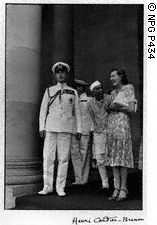
Nehru and Lady Mountbatten were good friends. What was the relationship between them? Obviously one of an intimate friendship. One (JN) had been moulded and influenced by England. The other (Lady M) had been influenced by India. Both were friends because they found something novel in a person affected by the thing he or she loved. He was aristocratic and so was she. And both were in love with people, feeling for them, wanting to help them, dedicating their lives to the service of others.

There was forthrightness about Lady M which was typically English, and so was the clipped accent, the high-powered smile and the short, sudden gasp of breath with which ‘pucca’ English women indicate surprise or boredom, or do it merely because they do it so well, so often.

Her feminity was utterly charming. The sweet kisses to the ladies, the testering high heels, the smart frocks, the nail polishing in the plane (“my nails are all clipped trying to pull the ashtrays out in this Russian plane”), the exquisite perfume and the totally unconcerned manner of the gay ‘20’s with which she powdered her face at the breakfast table - all these - I noted with fascination.
-x-x-x-x-x-x-x-x-x-x-x-x-x-x-x-x-x-x-x-x-x-x-x-x-x-x-x-x-x-x-x-x-x-x-x-x-x-x-x-x-x-
www.indyeahinc.com is your one-stop info hub for all things related to Biz, Finance, Marketing, Management theory, Advertising and much more. Read, Comment, Submit your favourites articles or links to your own Blog. Join the community at www.indyeahinc.com
-x-x-x-x-x-x-x-x-x-x-x-x-x-x-x-x-x-x-x-x-x-x-x-x-x-x-x-x-x-x-x-x-x-x-x-x-x-x-x-x-x-
‘Dickie’ always hovered about the edge of the conversation. ‘Dickie’ said this or that - was interested in this - was always right about military affairs, politics, fishing, whatever you want. And, of course, there was always something which could be taken back for him - paintings from the caves, guide books of Ajanta, a mango from the fruits served in the Aurangabad Hotel, gifts presented by village children. He was there all the time with us in the tours; if not in person, in the desire to please him.

Lady Mountbatten had a very young figure although her face looked elderly. Once seated next to her in the plane, I could not but help looking at her feet—delicate, thin, with a most pronounced arch – in fact an exaggerated arch, but very attractive. She was very particular about her clothes and appearance. She was the type of woman whom the PM seemed to like—independent, opinionated, cheerful, even brilliant in conversation but affectionate and sympathetic.

The other intimate friend of JN was Padmaja Naidu. One could write a lot about her and still fail to describe her kindness, her inimitable sense of humour, her poetic expression, her frankness and “say-what-you-will” attitude with JN, her undying love for her mother (Sarojini Naidu) which brought a tear in her eyes whenever she talked about her; her indefatigable championship of the Muslim widows of Osmanabad, and her tirade against Union officers, her interest in solid social work, her love for Hyderabad and her interest in pornography or her desire to wash her hair every day on tour. There was much about her that was noble and kind – and yet petulantly feminine. Padmaja Naidu was a good friend who was already to help with the type of advice that only a good woman can give.

Another woman who tried to get close to JN was Mridula Sarabhai. She became an absolute nuisance to the security people. Mridula Sarabhai, the heavy browed, tight-hipped woman with straight bobbed hair—heavy shoes, and a deep melancholy eyes seemed to be a frustrated woman. She seemed to have loved only one man—grandly, unapproachably, even unattainably - Nehru.

Her frustration found relief in “protecting him.” Every few days she circulated a letter to people high up, informing them of some vague secret conspiracy, which she had heard casually from a boy in the street when she was passing by. Or if it was not a conspiracy, it was some slackness in security in Parliament, in the PM’s house or in the Delhi Police.

One reason for the letters was her desire to protect JN and another and perhaps more important reason was to attain influence in the political and official world. To everyone in the Congress and the Secretariat, she was a friend of Nehru, although JN himself could see through her game.